


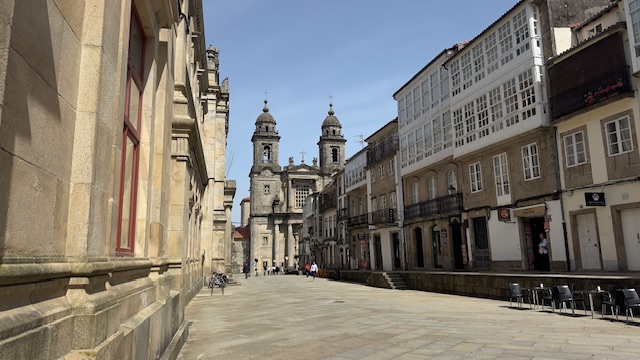
Did you know that over 400,000 people walk the Camino de Santiago every year, but almost none of them do it with a house on wheels? While other pilgrims rush to find hostels or shower with freezing cold water, you could be sleeping in your own bed, cooking your favorite dinner, and waking up next to a forest, right by the trail. This is not a dream. It is simply doing the Camino de Santiago in a motorhome.
But of course, questions immediately come to mind: where can you park? Is it allowed to spend the night near the route? Are there services for motorhomes? And what do you do about the stages, since the Camino is meant to be walked? Here you will find all the answers, straight to the point and with real-life examples, so you can clear up your doubts and start planning your own adventure on wheels towards the Apostle’s tomb.
Why doing the Camino de Santiago in a motorhome changes the game
Most pilgrims carry a backpack of 8 or 10 kilos, just enough to survive. You, on the other hand, can bring spare clothes, a good jacket, home-cooked food, and even a folding chair to watch the sunset. The motorhome is your base camp. You move at your own pace, sleep where you want, and don’t depend on last-minute reservations at hostels that fill up by four in the afternoon.
Furthermore, doing the Camino de Santiago in a motorhome allows you to combine two things that seem opposite: the company of other pilgrims and your own space. During the day, you walk with people from all over the world, share stories, have a coffee in a square. When you finish the stage, you return to your rolling home, close the door, and have silence, privacy, and a hot shower. That is priceless.
First things first: can you sleep on the Camino with a motorhome?
Here is the issue that worries people the most. No, you cannot park just anywhere. You cannot just arrive and sleep in the first pretty meadow. Spain has laws. But there are many legal and safe options.
Overnight and motorhome areas on the French Way
The most famous route, the French Way, has more and more service areas for motorhomes. From Roncesvalles to Santiago, you will find parking lots with grey and black water dumping, battery charging, and sometimes electricity. Some are paid (usually between 10 and 20 euros per night) and others are free, though without services. Large towns like Pamplona, Logroño, Burgos, León, Ponferrada, and Sarria have specific areas.
There are also campsites. Many are close to key stages and accept motorhomes. They have bathrooms, laundry, and, if you feel like it, a swimming pool in summer. It is not the same as sleeping in the open countryside, but they offer security and complete services.
Clear prohibitions: no free overnight stays in urban centers or protected natural areas
In cities and towns with fewer than 10,000 inhabitants, the law allows parking but not “camping” (taking out chairs, tables, awnings). In rural areas, you can only sleep inside the motorhome without deploying exterior elements. In natural parks or biosphere reserves, free overnight stays are completely forbidden. Get informed well for each stage to avoid a €200 fine.
The best Camino to do by motorhome (not all are suitable)
Not all Caminos are equally easy. The French Way is the best prepared because it has more infrastructure. The Northern Way, with its cliffs and beaches, is spectacular but has narrow roads and fewer motorhome areas. The Portuguese Way, from Tui, is short and very accessible. The Primitive Way is beautiful but has climbs that would scare more than one large van.
If it is your first time, choose the French Way from Sarria (the last 115 km) or from León (about 300 km). These areas have good roads, many towns, and service areas every 20-30 km. This way you avoid complications and enjoy more.
Plan your stage: you cannot walk and drive at the same time
A motorhome does not walk by itself. You have to decide how to organize your day. There are two main strategies.
Option A: Your personal shuttle
Leave the motorhome in the morning at the point where you will finish your stage. Take a car or taxi to the start of the route (or even better: use local public transport). Walk towards your vehicle. When you arrive, your home is already waiting for you. It is like having a private shuttle. However, you need two vehicles or combine with rural buses, which work quite well in Galicia and Castile.
Option B: Move ahead and go back
Drive in the morning to the end of the next stage, leave the motorhome well parked, take a taxi back to where you started yesterday, and walk to your vehicle. The next day, repeat: move forward a bit more, leave the van, go back by bus or taxi. It is slower, but you do not need an extra car.
Option C: You walk while someone else drives
If you are going as a couple or group, one person walks a stage and the other drives the motorhome to the end, parks it, and walks back to meet the first person. You take turns. This is the most flexible, but requires coordination.
None is perfect. The key is to accept that you will not do the traditional Camino from hostel to hostel. Your Camino will be hybrid: you walk a part, drive another, and enjoy landscapes that others miss because they walk with their heads down.
Where to find water, dumping stations, and diesel on the Jacobean route
A motorhome needs three things: clean water, emptied tanks, and fuel. On the Camino de Santiago, there are solutions.
- Motorhome areas: The best option. Apps like Park4Night or Campercontact show you all of them, with reviews and prices. On the French Way, you have at least one every 50 km.
- Gas stations with motorhome service points: Some large gas stations (Repsol, Cepsa, Campsa) have dumping and water points. Always ask.
- Campsites: You pay a day rate (about 10-15 euros) and use all their services even if you do not sleep there.
- Commercial vehicle workshops: Sometimes they let you dump for a small donation.
- Small town halls: In villages with few resources, ask at the town hall. Many have a tap for cleaning streets and, if you are polite, they will let you fill your water tank.
Do not wait until you are at 10% water or with a full grey water tank. Plan with margin. In summer, water points are scarce, and in winter, some are closed.
What to bring in your motorhome for the Camino de Santiago (what you need and what you don’t)
Space in a motorhome is limited, but much larger than a backpack. Use it well.
Must-haves
- Offline maps of the Camino (apps like Buen Camino or Wise Pilgrim).
- Sunscreen and mosquito repellent (in summer, there are tiger mosquitoes in Galicia).
- First aid kit with band-aids, bandages, alcohol, and above all, sports tape for blisters. Blisters are enemy number one.
- Quick-dry clothes and several changes. You do not need much weight, but you always need something dry.
- Spare shoes for after walking. Your feet need to breathe.
- Trekking poles. On steep downhills, they save your knees.
- A 10-meter hose to fill water if the tap is far away.
- Electric cables with European adapters.
You don’t need to bring
- Food for two weeks. On the Camino, there are supermarkets every few kilometers. Buy as you go.
- Two pairs of boots. One well-cushioned pair is enough.
- Heavy books. Bring an e-reader or audiobooks.
- Large outdoor furniture. Two lightweight folding chairs and a small table are more than enough.
The 5 essential stages to do the Camino de Santiago by motorhome (with practical tips)
You cannot do all the stages on foot if you want to move forward with the van. You will always remember these five.
1. From Roncesvalles to Pamplona (first contact)
Start in Roncesvalles, where the famous collegiate church is located. There is a motorhome area right next to it. The stage to Zubiri is downhill through beautiful forests. The next day, on to Pamplona. In Pamplona, you have the Landaben motorhome area, with all services. Take the chance to see the San Fermín route and eat a tortilla pincho on Estafeta street.
2. From Logroño to Santo Domingo de la Calzada (wine and the miracle of the hens)
Logroño has a motorhome area by the Ebro river. The stage to Nájera is flat and passes through vineyards. In Santo Domingo de la Calzada, do not miss the cathedral with the live hen house. You can sleep in the free area at the town entrance, but without services. Make sure to fill up with water in Logroño.
3. From León to Astorga (the Maragato region and sweets)
In León, the motorhome area is in the Onzonilla Industrial Estate, 3 km from the center. Take a taxi to visit the Cathedral and the San Marcos Hostal. The stage to Astorga is about 50 km along a local road, with some hills. Astorga has a paid area near the football stadium. Try the mantecados and chocolate with churros. Do not say no.
4. From Ponferrada to O Cebreiro (the great mountain challenge)
Ponferrada has a huge motorhome area next to the Templar castle. From here, the climb to O Cebreiro begins, the toughest on the French Way. Your motorhome needs good power if it is large, because there are ramps of up to 12%. O Cebreiro is at 1,300 meters and can snow in winter. Sleep in the area at the town entrance, but book ahead in summer because it fills up. At night, go to mass and hear the legend of the Holy Grail.
5. From Sarria to Santiago (the last 115 km, the busiest)
Sarria is the point where most people start to get the Compostela. There is a motorhome area at the town exit, towards Lugo. From here, the Camino becomes crowded with pilgrims. The most beautiful stage is from Portomarín to Palas de Rei, passing by the Miño river and eucalyptus forests. In Santiago, park at the Monte do Gozo area, only 4 km from the cathedral. From there, a city bus runs every 15 minutes. When you arrive at the Obradoiro square, do not forget to hug the Apostle.
Real problems (and real solutions) of the Camino de Santiago by motorhome
Not everything is beautiful. You will go through situations that a normal pilgrim does not experience. Here they are so you are not caught off guard.
Problem 1: Traffic jams on secondary roads. In August, rural roads fill with pilgrims walking in a line. Your motorhome is wide. Be patient. Do not honk, do not overtake on curves. Drive very slowly (20 km/h) and wait for them to move aside. Most are friendly if you give them time.
Problem 2: Wind on the mesetas. From Burgos to León, the north wind can shake the motorhome like a tin of tuna. If you feel the wind exceeds 40 km/h, find a sheltered parking spot next to a tall building or stop until it calms down. It is not worth the risk.
Problem 3: Breakdown in a lost village. Always carry the phone number of your travel assistance insurance. Not all rural workshops handle large motorhomes. Save the numbers of specialized workshops in provincial capitals on your phone. And an external battery charged for your mobile.
Problem 4: Night noise in free areas. Sleeping near a road or a football field can be hellish. Bring silicone earplugs. Or better, pay 15 euros at a private area with guaranteed security and silence.
When is the best time to do the Camino by motorhome (and when not)
Spring (April-June): The best time. Long days, mild temperatures, green fields, and fewer pilgrims than in summer. Motorhome areas are not saturated. The only problem: some rain in Galicia, but an umbrella and a waterproof jacket solve it.
Summer (July-August): Very hot on the meseta (over 35 degrees in the shade). You will need air conditioning running, and that drains the battery. Areas fill up before 5:00 PM. Advantage: very long days to walk until 9:00 PM. Disadvantage: overcrowding in the last 100 km.
Autumn (September-October): Also ideal. The forest colors are stunning. Temperatures are perfect for walking. Rains start in October, but the green landscape is worth it. Many areas close on October 31st, so check.
Winter (November-March): Only for the brave. Mountain passes like O Cebreiro or Alto del Perdón close due to snow. Many motorhome areas have no dumping service because pipes freeze. If you go for it, bring chains, a full butane gas heater, and thermal clothing. And check road conditions every morning.
Real budget for the Camino de Santiago by motorhome
Many people think it is more expensive than hostels. Well, it depends. A hostel costs an average of 12 euros per person per night. A motorhome, if you sleep in a paid area (15 euros), plus diesel (about 15 euros every 100 km), plus water and dumping (sometimes included, sometimes 3-5 euros). It is more expensive, yes. But you have privacy, your own kitchen, a fridge, and you do not pay for a restaurant every day. If you cook in the van, you save. If you eat out, you spend like a normal pilgrim.
A quick breakdown for one week (2 people):
- Overnight in areas: 7 nights x €15 = €105
- Diesel for 500 km: about €75
- Groceries from supermarket: €100
- Two meals out (to celebrate): €40
- Extras (taxi, bus, laundry): €50
- Total week: €370 (€185 per person)
In hostels, with eating out: about €250-300 per person. Not such a big difference, and you sleep much better.
Frequently asked questions (and direct answers)
Do I need the Pilgrim’s Credential if I go by motorhome? Yes. You get it at any hostel, cathedral, or friends of the Camino association. You stamp it every day at churches, town halls, or bars. Without it, you do not get the Compostela in Santiago.
Can I bring my dog? It depends. In many motorhome areas, yes, but in some, no. Hostels do not allow animals. Your dog can come, but will not be able to sleep in enclosed areas or enter monuments. However, the Camino is very pet-friendly with walking pilgrims. Always bring a leash and bags to pick up waste.
Where can I shower if I do not want to use my motorhome? At municipal sports centers in large towns (2-3 euros), at luxury motorhome areas, or at campsites. Some bars offer a shower for 1 euro if you buy something.
What if the motorhome gets stuck on a dirt track? Do not go on roads that are not paved asphalt. Always follow signs for vehicles. If the GPS sends you down a path, ignore it. Motorhomes are not 4x4s.
Why renting a motorhome for the Camino makes all the sense in the world
Maybe you do not own a motorhome. Maybe you do not want to buy one because you will not use it afterward. So you rent. It is cheaper, you do not pay annual insurance, you do not worry about maintenance. And you can choose the right size for your trip: a small camper van for two people, or a large one with a shower and toilet for the whole family.
In Madrid, you have serious options, with vehicles that have been checked, insurance included, and advice for planning the route. Renting any van is not the same as renting a motorhome prepared for the Camino, with thermal insulation, good batteries, and water tanks sufficient for two days without service.
If you are thinking about doing the Camino de Santiago in a motorhome but do not have your own vehicle, the smartest solution is alquiler de Casa Rodante en Madrid. This way you arrive at the starting point stress-free, with a vehicle in perfect condition and with everything you need so that your only concern is walking and enjoying.
The Camino de Santiago by motorhome is not the typical Camino. It is slower, freer, more your own. You do not have to ask for a bed in a hostel or eat expired cheese sandwiches. You set the pace, you choose the landscape, you decide whether to walk 10 km or 30 today. And when you arrive in Santiago, after hugging the Apostle, you turn around, look at your motorhome, and think: “I did that so well.”
Now only one step remains. Call, ask, book. At Autocaravanas Camperdadi, they help you choose the perfect vehicle for your Camino. Call +34 91 082 06 32 or send them a WhatsApp at +34 639 266 865. You can also email them at info@autocaravanascamperdadi.com. Ask without obligation, tell them how many days you are going, how many of you there are, and which stages you want to do. They have already helped dozens of pilgrims on wheels. You could be next. Buen Camino, and may the motorhome be with you.