


There is a secret that pilgrims on foot don’t usually tell you. There is a way to experience the ancient route without sharing bunk beds in noisy hostels, without carrying a ten-kilo backpack on your back, and, above all, always having the best views of Navarra, La Rioja, and Castilla right when you open your bedroom door. But beware, because doing the camino de Santiago desde Roncesvalles en autocaravana has a fundamental trick in the planning: if you don’t know where to empty water or which mountain passes to avoid, your dream trip can get complicated before you even reach Logroño. Stay until the end because I’m going to reveal the exact spot in the Pyrenees where you can watch the sunrise alone, far from the crowds.
Why Choose the French Way for Your First Adventure on Wheels
The route that begins in the Navarrese Pyrenees is the most famous in the world. Doing the camino de Santiago desde Roncesvalles en autocaravana allows you to enjoy an infrastructure that other routes lack. As it is the most traveled path, the towns are better adapted, there are more gas stations, and, most importantly, a network of overnight parking areas that makes life much easier for the traveler.
From an expert’s point of view on itinerant routes, Roncesvalles is the perfect starting point. It is a mystical place, surrounded by beech forests and a mist that seems straight out of a medieval knight movie. Starting here means crossing the entire peninsula from east to west, watching the landscape change from green mountains to the yellow wheat fields of Castilla, ending in the humid forests of Galicia.
The Freedom of Carrying Your Home With You
The biggest advantage is control. On the traditional Camino, if you arrive late to a hostel, you run out of a bed. In your house on wheels, that doesn’t happen. You have your kitchen, your private bathroom, and your bed with your own sheets. If a town makes you fall in love, you stay another night. If a section seems less interesting, you advance a few extra kilometers without excessive physical fatigue.
Preparations Before Starting the Engines
Before getting behind the wheel, you need to secure the vehicle. If you don’t have your own, the ideal is to look for a reliable service. Many travelers coming from abroad or from the capital opt for a Alquiler de Casa Rodante en Madrid to pick up the vehicle at a central point in Spain and from there head up toward Navarra. This allows you to check that everything is working correctly before entering the mountain roads.
Always check these basic points:
- Oil and coolant levels.
- Tire pressure (including the spare).
- Operation of the water pump and heating (it gets cool in the north even in summer).
- Charge of auxiliary batteries.
Roncesvalles: The Mystical Starting Point
Arriving in Roncesvalles is stepping into history. It is located at an altitude of about 900 meters. If you go in winter, snow chains or winter tires are mandatory, as snow is very common. Around the Collegiate Church, there are parking lots where you can park, but for sleeping, it is better to look for specific signposted areas to avoid fines.
An expert tip: before leaving, get your pilgrim credential stamped. Even if you go by motor, having the document with stamps from each stop is a precious souvenir and allows you to access some specific services for pilgrims in certain locations.
Stage 1: From the Pyrenees to the Basin of Pamplona
The descent from Roncesvalles toward Pamplona is beautiful but requires attention. You will pass through villages like Burguete and Espinal. The roads are narrow and curvy, so drive slowly and enjoy the Navarrese valley landscape.
In Pamplona, you have an excellent motorhome area in the Trinitarios neighborhood. It is very close to the historic center, and you can take an elevator directly up to the city walls. Pamplona is much more than San Fermín; getting lost in its streets and trying its famous “pinchos” is a mandatory stop.
Logistics in Navarra
Navarra is a very “motorhome friendly” region. You will find gray and black water emptying points in almost all major towns. Take advantage of these points so that the tanks never get too full.
Stage 2: Tierra Estella and the Entrance to La Rioja
Leaving Pamplona heading west, the next key stop is Puente la Reina. This is where all the paths entering Spain meet. The Romanesque bridge is a jewel you must photograph. There are large parking areas at the entrance of the village.
Continuing toward Estella, you will notice the landscape becomes drier and more Mediterranean. Estella is known as the “Toledo of the North” for its heritage. Nearby is the famous Wine Fountain of Bodegas Irache, where free wine comes out for pilgrims. Even though you are driving and shouldn’t drink, it is a curiosity worth seeing.
Arrival in Logroño
Logroño is the capital of La Rioja and a gastronomic paradise. You have a free overnight area near the Ebro River. From there, you can walk to Calle Laurel to enjoy the tapas culture. Remember, when traveling by motorhome, if you drink a glass of wine, you must wait the necessary time or spend the night right there before continuing the route.
Stage 3: Crossing the Plains of Castilla
This is the part that many pilgrims on foot fear due to the monotony of the landscape and the sun, but for us, it is a pleasure. Entering the province of Burgos means seeing infinite horizons.
Burgos city has a magnificent motorhome area near the Bullring, a short walk from the center. The Cathedral is, quite simply, impressive. Don’t forget to try the Burgos black pudding (morcilla) and the local cheese; these are foods that keep well in the camper’s fridge and will give you great dinners.
The Plateau: Tierra de Campos
From Burgos to León, you will cross the province of Palencia. It is an area of small villages with a lot of history, such as Frómista, where the church of San Martín is located, one of the jewels of Romanesque architecture. The roads here are long straights, ideal for relaxed driving. Make sure to keep the fuel tank full, as gas stations are a bit further apart.
Stage 4: León and the Climb to the Mountains of León
León deserves at least a full day. Its cathedral with unique stained glass windows and the Barrio Húmedo for dinner are essentials. There is a service area in front of the Espacio León shopping center, very safe and well-connected.
From here, the terrain starts to climb again. We head toward Astorga. This city is famous for its Episcopal Palace designed by Gaudí and for its chocolate. It is a good place to restock and rest before the climb to the Cruz de Ferro.
The Challenge of Cruz de Ferro and O Cebreiro
This is the highest point of the Way. The road climbs quite a bit, but it is in good condition. At the Cruz de Ferro, tradition says you should throw a stone brought from home. With the motorhome, you can park nearby and enjoy the silence of the mountain.
Afterward, we will descend to El Bierzo, with Ponferrada and its Templar Castle as the main attraction. Ponferrada has very comfortable areas for overnight stays and is the last great plain before entering Galicia.
Stage 5: Galicia, the Final Stretch Toward the Goal
Entering Galicia through O Cebreiro is a magical experience. The “pallozas” (circular stone houses with thatched roofs) tell you that you are in a different land. The O Cebreiro pass is steep; if your motorhome is old or has little power, take it easy and use low gears to avoid overheating the engine.
In Galicia, the landscape becomes an intense green. You will see many “no overnight parking” signs outside of designated areas, especially near the coast or in very touristy zones. Always respect local regulations so that we continue to be welcomed.
Sarria and the Last 100 Kilometers
Sarria is where many pilgrims on foot start their journey to obtain the Compostela. In a motorhome, you will notice much more movement of people. The villages follow one another quickly: Portomarín (which was moved stone by stone due to a reservoir), Palas de Rei, and Arzúa (famous for its cheese).
Arrival in Santiago de Compostela
You have arrived! Entering Santiago with a large vehicle can be a bit daunting, but don’t worry. Do not try to enter the historic center. There is a paid parking lot called “Salgueiriños” that functions as an official motorhome area. It is very well organized, has all services, and a bus that takes you to the center in 10 minutes.
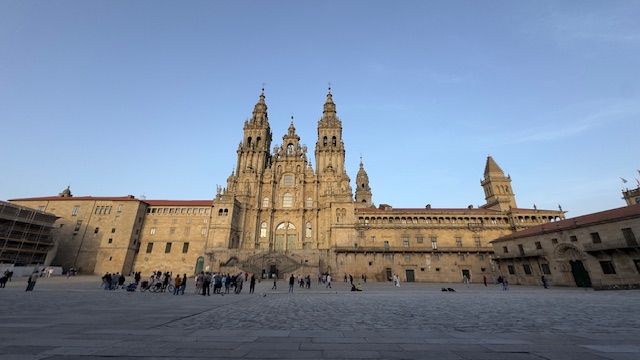
Walking toward the Plaza del Obradoiro and seeing the facade of the Cathedral is the pinnacle of the trip. Even if you haven’t made the physical effort of walking 800 kilometers, the emotional journey and the landscapes you have seen from your window create a special connection with the route.
Survival and Coexistence Tips
To make your experience perfect, apply these golden rules:
- Responsible emptying: Never empty your gray water in just any sewer. Always use the areas designated for it. The Camino is a heritage site we must protect.
- Shop local: In the small villages of Castilla and Galicia, try to buy bread, fruit, or wine at local shops. It is a way to give back for the hospitality of these lands.
- Noise: Motorhome areas are usually quiet places. Avoid playing loud music or using generators at night.
- Helpful Apps: Download apps like Park4Night or Caramaps to see updated reviews from other travelers about overnight spots.
What to Carry in the Motorhome for the Camino
In addition to clothes and food, there are certain items that will make your life easier on this specific route:
- Leveling blocks: Many northern villages have sloping streets. Without blocks, you will sleep at an angle and the fridge might not work properly.
- Hose and adapters: You will find different types of taps in service areas. Carrying a universal connection kit is key.
- Headlamp: Useful for checking gas or levels if you arrive late to a place without lighting.
- Camera: Sunrises on the Castilian plateau are something you will want to remember forever.
The Best Time to Make the Trip
If you are looking for tranquility, May, June, and September are the ideal months. The weather is mild and there are no crowds like in July and August. In winter, the Camino is beautiful and very solitary, but be prepared for intense cold in Burgos and León, and constant rain in Galicia.
If you decide to go in winter, make sure your heating system works perfectly and carry propane instead of butane, as propane does not freeze at low temperatures.
Safety on the Route
The Camino de Santiago is generally very safe. However, as on any trip, do not leave valuables in sight when you park to visit a cathedral or monument. Use safety locks on the doors and, if you can, install a small alarm.
In official overnight areas, the sense of community is very high and users themselves usually keep an eye on each other, which provides great peace of mind.
Estimated Budget
Traveling by motorhome allows you to save a lot on restaurants and hotels, but there are fixed costs to consider:
- Fuel: This is the main expense. The route from Roncesvalles to Santiago is about 800 km, plus any detours you take.
- Tolls: On this route, there are almost no tolls if you take the Camino Highway (A-12) and the A-231.
- Overnight stays: Many areas are free, but some private ones can cost between 10 and 20 euros per night with electricity.
- Food: This will depend on how much you cook in the van and how much you go out for tapas.
As I promised at the beginning, there is a special place. When you arrive in Roncesvalles, instead of staying in the village, head up toward the Ibañeta pass at dawn. You will be able to see how the clouds get trapped in the valleys while the sun begins to illuminate the peaks. It is the absolute silence you will hear on the entire trip. It is the moment you understand that the Camino is not just a destination, but every kilometer you travel with your house on your back.
If you are thinking of embarking on this adventure and need a vehicle that won’t fail you, at Autocaravanas Camperdadi we have the perfect fleet so you only have to worry about enjoying the landscape and the stamps on your credential.
If you want more information for your trip, you can contact Autocaravanas Camperdadi at +34 91 082 06 32 or send us a WhatsApp at +34 639 266 865. You can also write to us at info@autocaravanascamperdadi.com.